
How Content Influences the Customer Journey
Introduction
Before making a purchase, customers usually go through several steps.
They may first hear about a brand through social media. Then they might search on Google, read a blog, watch a video, check reviews, visit the website, compare different options, and finally decide whether to make a purchase.
What connects many of these steps?
Content.
Content is everywhere in digital marketing. From Instagram posts and blog articles to videos, emails, reviews, websites, and guides, businesses use content to communicate with their audience.
But content is not simply about posting regularly.
The right content can help a customer understand a problem, discover a solution, trust a brand, compare options, and eventually make a confident decision.
This is why understanding the customer journey is important for every business.
Instead of asking, “What should we post today?”, businesses should start asking:
“What does our customer need to know at this stage?”
Let’s understand how content can influence every step of the customer journey.
What Is the Customer Journey?
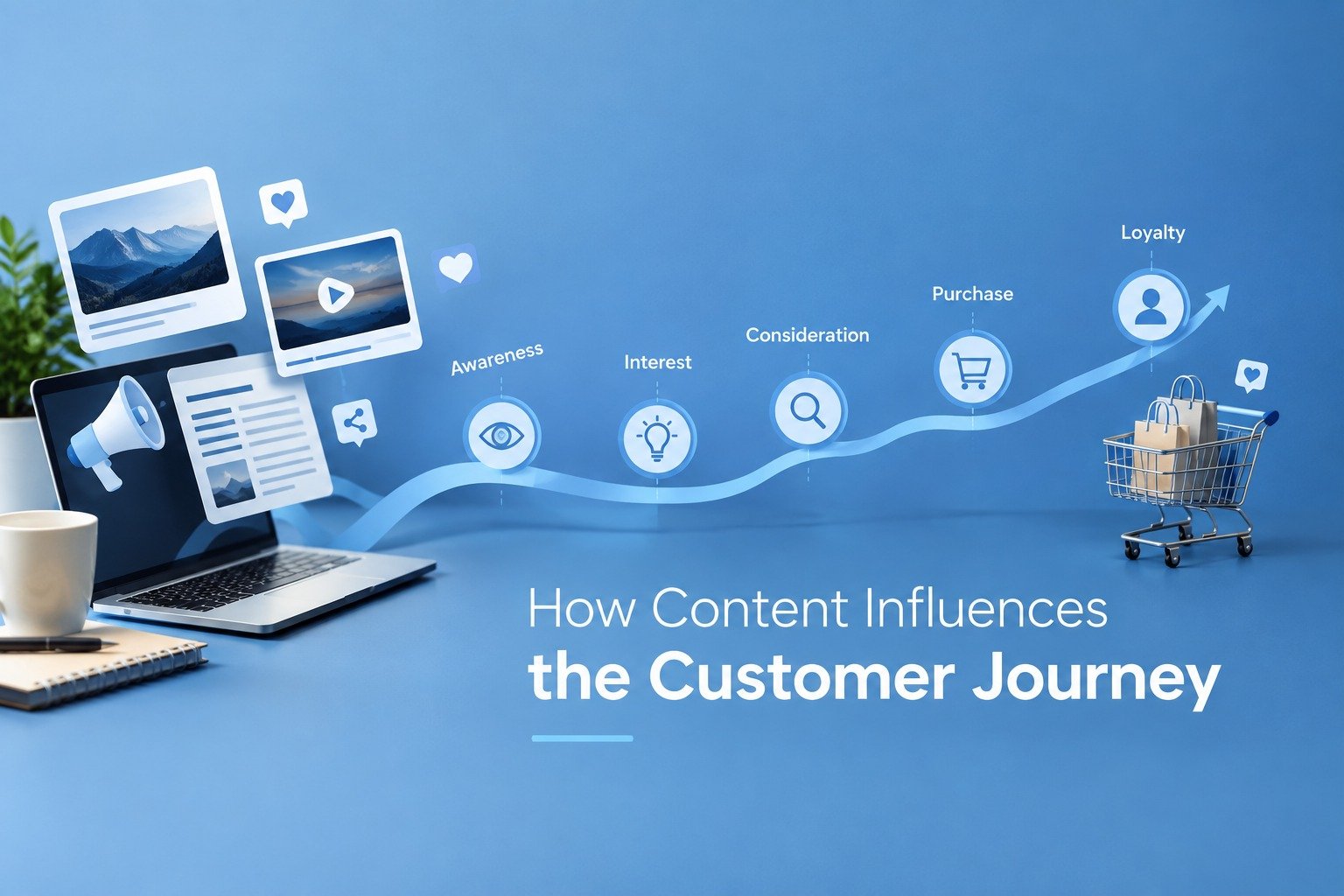
The customer journey is the process a person goes through before, during, and after purchasing a product or service.
While every customer journey is different, it can generally be understood through four important stages:
Awareness
Consideration
Decision
Post-purchase
Each stage has a different purpose, and the content you create should support the customer’s needs at that particular moment.
1. Awareness: Helping People Discover Your Brand
The first stage is awareness.
At this point, customers may not even know that your brand exists. They may simply be experiencing a problem or looking for information.
For example, imagine someone wants to improve their business’s online presence.
They may search:
“How can I get more customers online?”
They are not necessarily looking for a particular company yet. They are looking for information.
This is where educational content can help.
Useful content for the awareness stage:
Blog posts
Instagram posts
Short videos
YouTube videos
Infographics
Educational guides
Social media tips
The goal at this stage is not to push a sale.
The goal is to provide value and create awareness.
If your content helps someone solve a small problem or understand something better, they may remember your brand.
A simple tip:
Don’t make every post about your product or service.
Sometimes, the best way to introduce your brand is by helping people before asking them to buy.
2. Consideration: Helping Customers Explore Their Options
Once people become aware of a problem and possible solutions, they enter the consideration stage.
Now they want more information.
They may ask:
Which solution is right for me?
What are the benefits?
How much does it cost?
Which brand should I choose?
What makes one option different from another?
Is this product or service worth it?
This is where deeper content becomes important.
Customers are no longer just looking for basic information. They are researching.
Content that works well at this stage:
Detailed blog posts
Product or service pages
Comparison content
Case studies
Demonstration videos
FAQs
Expert guides
Webinars
Customer stories
For example, a web development company could create a blog explaining:
“What Should a Small Business Look for in a Website?”
This type of content helps potential customers understand what they actually need.
It also gives the business an opportunity to demonstrate knowledge and expertise.
The key here is education.
Don’t try to force the customer to choose you.
Give them enough useful information to understand their options.
When customers feel informed, they are more comfortable moving to the next stage.
3. Decision: Giving Customers Confidence to Buy
The decision stage is where customers are closer to making a purchase.
They may already know what they need and may have shortlisted a few brands.
Now the questions become more specific:
“Why should I choose this brand?”
This is where trust becomes extremely important.
Customers want proof that a business can deliver what it promises.
Content that can support the decision stage:
Testimonials
Customer reviews
Case studies
Product demonstrations
Portfolio examples
Pricing information
Service details
Frequently asked questions
Before-and-after examples
For example, if you are offering digital marketing services, simply saying:
“We provide SEO services.”
may not be enough.
Showing previous work, explaining your process, sharing results where appropriate, and answering common questions can give potential clients a clearer picture of what working with you could look like.
A useful principle:
Don’t just tell people what you can do. Show them.
Proof can make your communication much stronger.
4. Post-Purchase: Content Doesn’t Stop After the Sale
Many businesses focus heavily on getting customers but forget what happens after the purchase.
The customer journey does not end when someone buys.
After purchasing, customers may need help understanding the product, using a service, solving a problem, or getting the most value from their purchase.
This creates another important content opportunity.
Post-purchase content can include:
How-to guides
Tutorials
Email tips
Product guides
FAQs
Customer support content
Maintenance tips
Helpful videos
Follow-up emails
Good post-purchase content can make customers feel supported.
And when customers have a positive experience, they may be more likely to return, recommend the brand, or share their experience with others.
Why the Right Content Matters
One of the biggest mistakes businesses make is creating content without understanding its purpose.
They may post every day but still struggle to generate meaningful results.
Why?
Because more content does not always mean better content.
The content should answer a customer’s actual need.
For example:
At the awareness stage:
“What is digital marketing?”
At the consideration stage:
“Which digital marketing strategy is right for my business?”
At the decision stage:
“Why should I choose this digital marketing service?”
After purchase:
“How can I get the best results from this service?”
The topic changes because the customer’s questions change.
That is why a successful content strategy should follow the customer journey.
Content Builds Trust
Trust is one of the most important factors in a customer’s decision.
People don’t want to spend money on something they don’t understand or don’t trust.
Content gives businesses an opportunity to build that trust over time.
You can build trust by:
Sharing useful information
Being honest about your products or services
Answering questions clearly
Showing real examples
Sharing customer experiences
Avoiding exaggerated claims
Keeping information updated
Showing knowledge about your industry
Trust doesn’t usually happen after one social media post.
It is built through repeated positive interactions.
Every useful blog, helpful video, clear website page, and genuine customer review can contribute to that experience.
How to Create Content for Every Stage
If you’re planning your content strategy, start with your customer’s questions.
Step 1: Understand your audience
Find out:
Who are they?
What problems do they have?
What are they searching for?
What information do they need?
What stops them from making a decision?
Step 2: Map content to the journey
Create different types of content for different stages.
Awareness → Educational content
Consideration → Detailed and comparison-based content
Decision → Proof, testimonials, case studies, and clear offers
Post-purchase → Guides, support, and helpful resources
Step 3: Use different platforms
Don’t depend on only one platform.
Your audience may discover you through:
Google
Instagram
YouTube
LinkedIn
Email
Your website
Each platform can play a different role in the customer journey.
Step 4: Focus on quality
You don’t need to create content simply for the sake of posting.
One genuinely useful piece of content can be more valuable than several posts that provide little information.
Ask yourself before publishing:
“Will this help my audience?”
If the answer is yes, you’re moving in the right direction.
Common Content Marketing Mistakes
Even good businesses can make mistakes with their content strategy.
1. Talking only about the brand
If every post is about your products, offers, or achievements, customers may lose interest.
Balance promotional content with educational and helpful content.
2. Creating content without a clear audience
Content should have a specific person in mind.
The more clearly you understand your audience, the easier it becomes to create relevant content.
3. Ignoring the decision stage
Some businesses create excellent educational content but don’t provide enough information to help customers make a final decision.
Include proof, testimonials, FAQs, and clear next steps.
4. Forgetting existing customers
Your existing customers are also an important audience.
Continue providing value even after the purchase.
5. Focusing only on trends
Trends can help increase attention, but not every trend is relevant to your audience.
Choose trends carefully and connect them to your brand’s purpose.
My Perspective
I believe good content should feel less like advertising and more like a helpful conversation.
When someone reads your blog, watches your video, or visits your website, they should feel that they learned something useful.
That is where content becomes powerful.
Instead of thinking only about “What can we sell?”, businesses should also think:
“What can we help our audience understand?”
That simple change can make content more meaningful.
A customer who receives value from your content may remember your brand when they eventually need a product or service.
And that is one of the real strengths of content marketing.
Practical Tips for a Strong Content Strategy
Here are a few simple tips you can start using:
Know your audience: Understand their needs, interests, and problems.
Answer real questions: Turn frequently asked customer questions into content.
Create content for different stages: Don’t focus only on awareness.
Use simple language: Make your content easy to understand.
Show proof: Use testimonials, examples, and case studies where appropriate.
Be consistent: Build a regular and realistic content schedule.
Repurpose good content: Turn one blog into social posts, videos, emails, or carousels.
Measure performance: Look at engagement, website visits, leads, conversions, and other relevant metrics.
Keep improving: Use audience feedback and performance data to improve future content.
Conclusion
Content plays a much bigger role in marketing than simply filling a social media calendar.
It can introduce a customer to a brand, answer their questions, help them compare options, build trust, support their buying decision, and continue the relationship after the purchase.
The most effective content is not always the content that gets the most views.
It is the content that reaches the right person with the right information at the right stage.
As customer expectations continue to change, businesses need to think beyond simply creating more content.
They need to create more relevant content.
Understand your audience. Listen to their questions. Give them useful information. Show them why they can trust you.
Because before customers buy from you, they often need to understand you first.
And great content helps make that journey easier.